The True Cost of Skipping Certified Mechanical Testing Services
Suppose your organization has come up with an excellent new product. Your team has spent months designing it, trying out prototypes and getting it ready for production. Everything looks perfect. You decide not to use certified mechanical testing services to save time and money. After all, material supplier already gave datasheet, so all should be fine.
After a couple of months a large issue arises. An essential part fails during normal usage. The customer begins to complain of failures, products are called back and your reputation is damaged. Warranty claims and potentially a lawsuit come up soon.
It appeared to be a cost cutting measure but turned out to be a costly mistake.
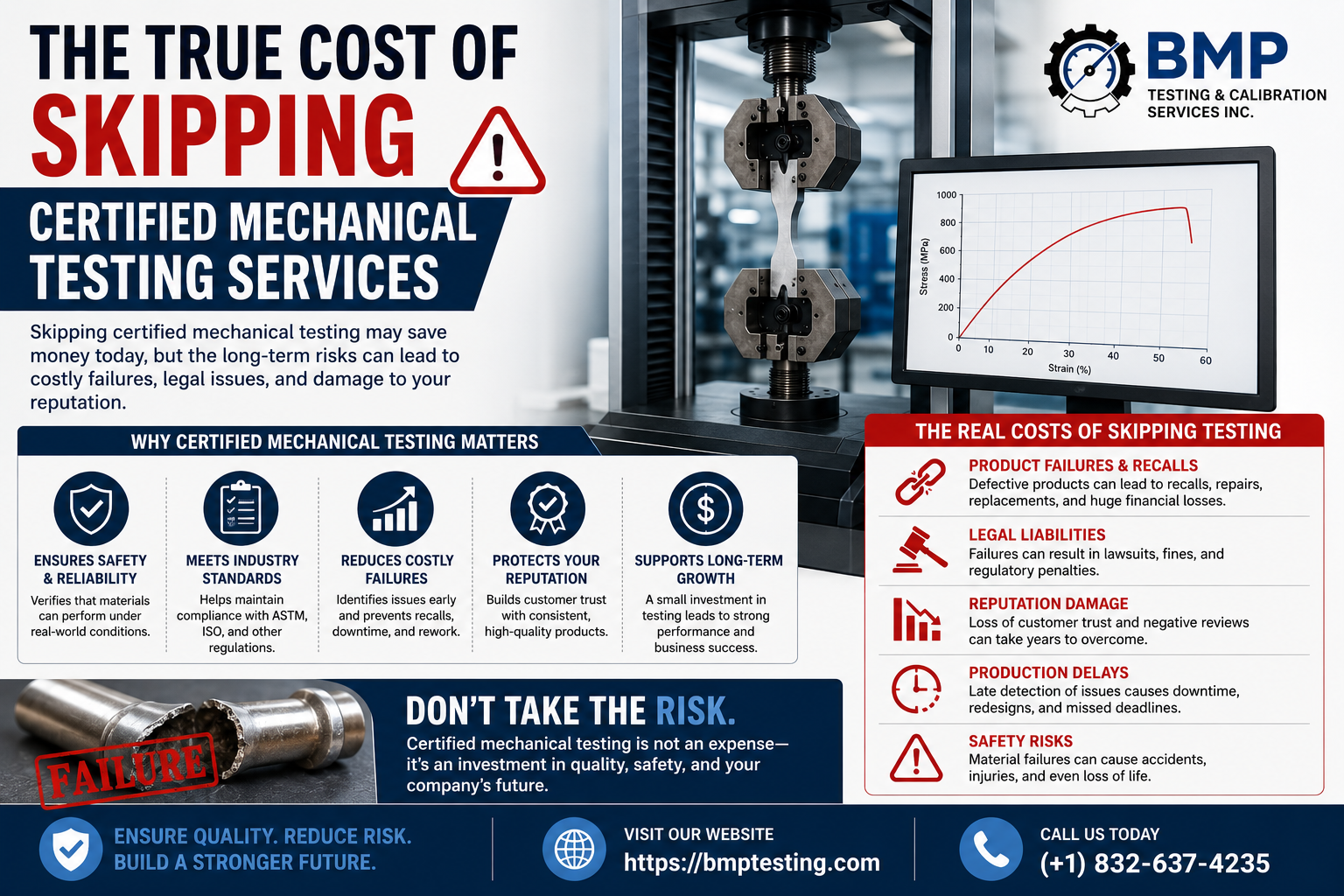
While certified mechanical testing services can be expensive, skipping them can cost a lot in the long run. Here are some of the biggest risks businesses face when they avoid certified testing.
Product Recalls Can Be Extremely Expensive
If, after the product reaches customers, the product is not as intended, companies have little alternative but to issue a recall. Product recalls can be expensive and present serious operational issues.
If there is no certified testing, there is no way to be certain materials will be able to withstand actual stresses, pressures, impacts or environmental exposure. A recall may result in costs including:
- Returned goods shipping and handling.
- Manufacturing replacement products
- Storing defective inventory
- Disposing of failed products
- Costs of customer compensation and support.
Certified testing services can help uncover material weaknesses before products are released into the marketplace, thus minimizing recall costs.
Legal Issues and Difficulties
There are industries that have to be carried out within a specific framework of regulations and quality standards. This is particularly the case for industries like:
- Aerospace
- Automotive
- Medical devices
- Construction
- Oil and gas
When a product fails and leads to injuries, property damage or safety issues, the company could be in a lot of trouble legally. The use of only supplier datasheets or internal testing can limit your ability to respond to legal investigations and regulatory audits.
These are tested by certified testing laboratories under the recognized standards, including ASTM and ISO. Their reports are a reliable document showing that your company has used appropriate quality control procedures.
Having certified test results can be valuable evidence if legal issues arise.
Damage to Your Company's Reputation
One of the best assets of a company is its reputation. Products need to be safe, reliable and durable for customers. If the products don't work, confidence can quickly be lost. In today's day and age, negative customer encounters are quickly shared via:
- Online reviews
- Social media posts
- Industry forums
- News reports
A few product failures can result in lost customers and reduced sales. It can take time and resources to restore that trust, including marketing efforts, customer service and quality improvement programs.
Mechanical testing services are certified and help safeguard your brand by ensuring products function as intended.
Increased Production Delays
Many businesses fail to test, as they want to release their products in early time. However, it is possible to avoid testing which leads to even greater delays later. Once a defect is identified during production or after the product has been released, the company might have to:
- Stop production
- Investigate the failure
- Redesign components
- Retest materials
- Restart manufacturing
These delays may impact delivery schedules and customer relationships.
During product development, it is beneficial to identify problems early (when they are easier and less costly to solve) through certified testing services.
Supplier Data is Not Always Enough
A frequent error is taking the material certificate from a supplier for granted as being all the information required. Suppliers do their best to ensure that accurate information is provided, but issues may arise.
For example:
- There may be batch-to-batch variation in material quality.
- Contamination can occur during transportation.
- Material properties can be influenced by the manufacturing process.
- Performance characteristics may be altered due to heat treatment and/or welding.
Certified Testing is an independent assessment of materials. It ensures that the materials received are of the correct specification and operate as expected.
Risks of staying safe go up considerably
A product failure may lead to significant safety issues. Failure of material/component can result in:
- Workplace injuries
- Equipment damage
- Structural failures
- Environmental incidents
- Product liability claims
Safety is paramount in some industries, and a failure can have a huge impact. To mitigate these risks, certified testing services can be used to ensure that materials perform as required for safety and performance before they are used.
Higher Long-Term Costs
Some firms do not want to test due to the cost. In fact, certified testing can typically save money in the long run. The expenses of testing are typically significantly less than the costs of:
- Product recalls
- Warranty claims
- Legal disputes
- Production delays
- Customer complaints
- Brand damage
Investing in testing enables companies to prevent problems that are costly and ensure that product quality is consistent.
Better Product Performance
Mechanical testing can be used to help manufacturers understand the performance of materials under various conditions. Tests may evaluate:
- Tensile strength
- Hardness
- Impact resistance
- Fatigue life
- Compression strength
This information can be used by engineers to make the right product selections and enhance product design. Consequently, products are more durable, reliable and efficient.
Supporting Innovation and Growth
The materials and technologies of modern industries are continually evolving. Mechanical testing can help a business to safely launch new products with minimal risk. Data from a certified test will be used to help with the following:
- Product development
- Material selection
- Design improvements
- Process optimization
Businesses that have invested in testing may stand to benefit from a competitive edge since they can confidently help produce quality products to the market.
Mechanical Testing is an Investment, NOT an Expense!
When considering costs, companies should not wonder, "Can we afford certified testing services? Rather, they should ask themselves, “Are we willing to have product failures, product recalls, lawsuits, and tarnished customer confidence?”
Certified testing services aren't just an additional manufacturing expense. They represent a valuable investment in product quality, safety, compliance and long-term business success.
Conclusion
Avoiding certified mechanical testing solutions can seem like a cost and time saver, however the risks are high. The costs of product failures, legal problems, production delays, safety concerns, and reputational damage can be much greater than the cost of testing.
Certified testing can confirm material performance, ensure regulatory compliance, boost product reliability, and safeguard customer trust. Hiring professional testing services can help companies minimize risk, enhance quality, and establish a better base for future expansion.
In today's competitive marketplace, certified mechanical testing is no longer an option, it's a necessary step in providing safe, reliable and successful products. Fur further details, you can visit https://bmptesting.com